Welcome to CareTranslate!
My inspiration for creating CareTranslate came from a realization that a healthcare system cannot genuinely care for its patients if it cannot communicate clearly with them. This project grew from observing the massive, tangible problems caused by communication failures in medicine. I saw alarming statistics indicating that poor communication is a critical public health issue. My core belief is that the true path to better healthcare doesn't always lie in developing a new drug, but in establishing a new depth of understanding.
About the Author
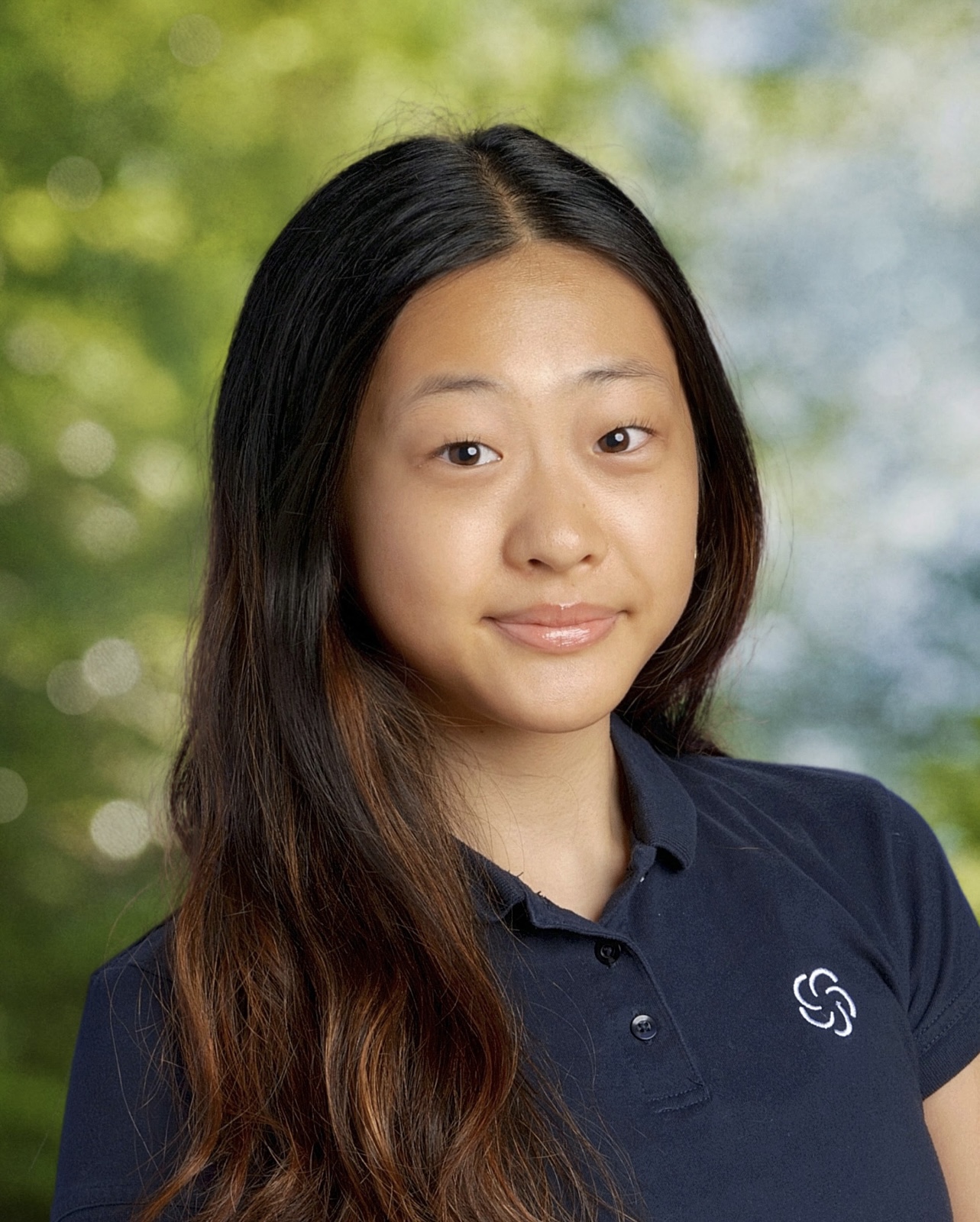
CareTranslate was developed by Sarah Zhou, a student at Castilleja School who believes that the path to better healthcare lies in establishing a new depth of understanding. She built CareTranslate to eto make medical information more transparent and truly accessible by tackling four distinct communication obstacles in healthcare.
Contact: sarahf.zhou@gmail.com
Problem Statement
Today, communication failures in healthcare cause nearly 70% of serious medical errors , which costs $1.7 billion in malpractice annually. Healthcare simply isn't accessible if patients are confused or feel misunderstood.
Four Major Points of Failure
Research made it clear to me that communication gaps in healthcare are a fundamental systemic problem. My design was directly inspired by the four major points of failure I identified:
- The Cultural Gap: Bridging differences in health beliefs that create friction and damage the patient-doctor relationship.
- The Age Gap: Reducing childhood fear and anxiety by replacing complex adult explanations with simple, non-threatening narratives.
- The Complex Term Gap: Empowering patients who feel misunderstood when confronted with complex jargon like "Cholecystitis".
- The Language Gap: Eliminating the risk of critical errors caused by inaccurate translation of prescription instructions.
The Solution
My application, CareTranslate, is an innovative web platform that utilizes Generative AI to act as a crucial communication bridge in healthcare. I built the app to offer context-aware explanations and translations, which are powered by Google's Gemini AI for deep contextual understanding. The technology dynamically adjusts the output based on the specific audience, whether that audience is a patient, a provider, or a child.
Key Features
🌍 Cultural Context Bridge
This feature provides practical, AI-driven guidance for handling sensitive cross-cultural conversations. For example, it helps a provider understand how to respectfully discuss mental health within an East Asian context.
👶 Kids' Explanation
Adapts complex health facts for younger audiences. For a 6 to 8-year-old, I designed it to explain a vaccine using comforting analogies, describing it as giving your body a "super strong army of tiny knights".
🏥 Medical Terms Simplification
This feature converts dense medical jargon, like "Myocardial infarction," into plain, straightforward English. Users can control the complexity level with a slider, which ensures the explanation is appropriate for their needs.
🗣️ Real-time Translation
This function specializes in high-accuracy translation of vital medical instructions and terms into more than 20 major world languages to eliminate the risk of critical errors.
Accessibility Tools
CareTranslate is designed to build a strong foundation of empathy, trust, and respect for all users.
🎤 Voice Input
For universal accessibility, I included a Speech-to-Text feature for voice input, which directly facilitates interaction for visually impaired users.
📚 Personal Dictionary
Additionally, CareTranslate has a "Save to Dictionary" feature that lets users save, search, and review all their translated terms offline.
Technical Challenges & Architecture
Building CareTranslate required architecting a system capable of complex, context-aware Natural Language Processing (NLP) while maintaining a low latency. You can explore the app's open-source code on GitHub.
The Challenge: Context-Aware Persona Switching
Unlike a standard dictionary, this system had to understand nuanced intent. I had to engineer the backend to dynamically switch functions:
- Simplification: Converting terms to plain English.
- Cultural Guidance: Generating respectful, actionable advice based on cultural norms.
- Age-Appropriate Analogy: Generating friendly narratives for children.
The Solution: Robust Prompt Engineering
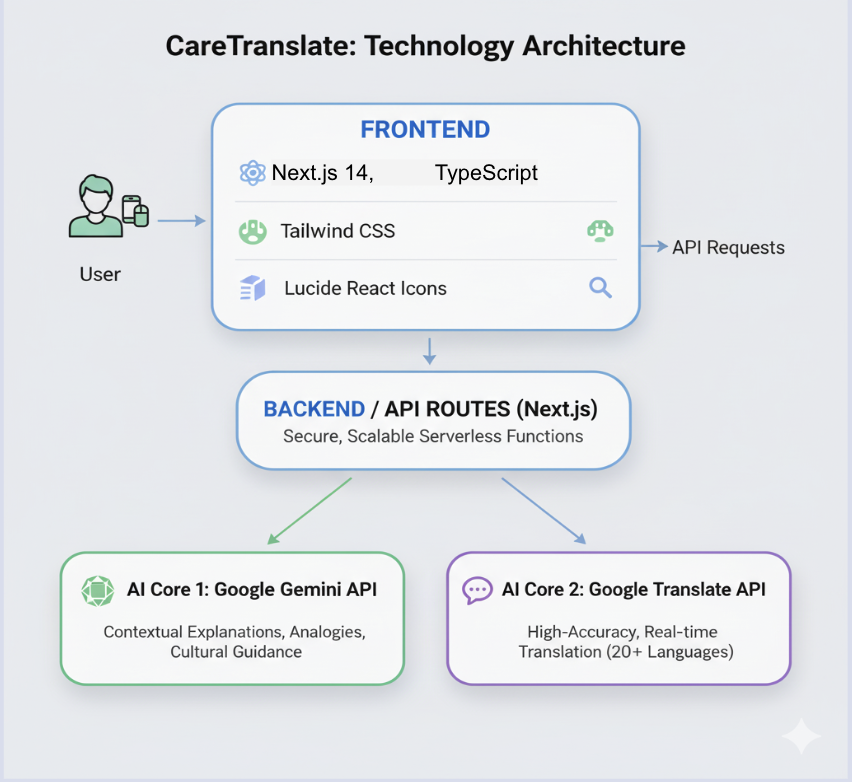
- Backend: I utilized Next.js API Routes to build a secure serverless backend. This required meticulous prompt engineering to ensure the Gemini model received clear instructions regarding target audience, tone, and output format.
- Verification: I utilized auxiliary Generative AI tools (ChatGPT) to verify the accuracy of cultural advice and contextual responses during development.
Tech Stack
- Frontend: Next.js 14 and TypeScript for state management and a fast, responsive UI.
- Styling: Tailwind CSS.
- AI Core 1: Google Gemini API (Contextual Explanations, Analogies, Cultural Guidance).
- AI Core 2: Google Translate API (High-Accuracy Real-time Translation).